What happens in the dark?
It's a question that feels particularly alive at this time of year, as darkness cloaks our world here in the Northern Hemisphere. The leaves are falling, things are decomposing, fungi are forming relationships, trees are returning their energy to their roots and reaching into the darkness. So much is happening beneath the surface, beyond what we can see.

In my last blog, I shared that I was off to spend Sunday in the dark. The Sunday after the clocks went back felt like the perfect opportunity. Spending that time in the dark led me to think about what it means to embrace darkness. When we can't rely on our eyes in the same way, we become aware of how much else we depend on: the things we feel, hear and sense; the subtle cues we usually overlook; the connections that are there whether we can see them or not.
Perhaps darkness doesn't take things away so much as draw our attention to what was there all along. A little like somatic movement.
What might be happening beneath the surface that we rarely notice? And what changes when we stop looking for what's visible and begin to pay attention to what we can feel?
We organise so much of our lives around what we can see, measure and bring into focus. We're encouraged to make things happen, get things done, measure progress and find answers. Even movement can become another project: how many reps, how fast, how far, how does it look? We learn to value what's visible, often overlooking everything that sits outside the frame.
But so much of life happens beyond what we can see. Beneath the soil, roots reach into the darkness and fungi form intricate relationships with plants and their surroundings. Within our bodies, networks of tissues connect us in ways we cannot see. And between people, relationships, histories and shared experiences shape us long before we find the words for them.
The unseen isn't the same as the absent.
In his essay Background, David Whyte describes what lies beyond our immediate sight as “a gifted treasure house for all of our human senses”. He invites us to notice the birdsong, the distant horn in the harbour, the wind stirring the branches of a tree. These things return us to the wider world, reminding us that we're part of something beyond whatever happens to be in the foreground.
Whyte suggests that when the foreground dominates our lives, we lose sight of the wider context from which it emerges. He connects this neglect of background with our present loneliness and unhappiness.
I've been thinking about this in relation to our bodies, too.
We tend to understand the body through what's visible and measurable: muscles, bones, shapes, strength, flexibility. We isolate particular areas to strengthen, stretch or improve, as though the body were a collection of separate components. But what about the relationships between those parts? The subtle shifts we might never see but can sometimes feel? The body moving as a connected, responsive whole?
And somehow, this brings me to fascia.
Fascia is connective tissue that surrounds and runs between muscles, organs, nerves and other structures. It helps form a continuous network throughout the body. The interstitium, which includes fluid-filled spaces within and between tissues, offers another glimpse of the complexity of our internal landscape.
We are not simply a collection of bits. We are layers, fluids, tensions and connections. A living web.
Last night, during the online Year-Long Pathway, we were exploring autumn. As we ‘harvested the group mind’ (thank you Paula, for this beautiful expression) and shared our thoughts and experiences, someone described autumn as feeling more ancient than summer. I loved that.
There's something about autumn that reaches beyond the brightness and expansiveness of summer. It carries a memory of preparation: gathering what we need, drawing things in, conserving energy. Beneath the surface, the living world is changing, responding and preparing for what comes next. We are part of that rhythm, too, whether or not we stop to notice it.
And perhaps sensing our bodies as interconnected, living systems changes how we move.
What happens when movement isn't about strengthening a particular muscle, stretching a tight hamstring or achieving a particular shape? What happens when we begin to sense weight travelling through the body, one part yielding as another responds, movement rippling rather than being directed? What happens when we experience movement as something ancient?
When we stop trying to make the body do something and begin to listen to how it is already moving?
This is part of what draws me to somatic movement. The invitation isn't to make a movement look a certain way, but to feel it from the inside. To notice the weight of a hand, the shift of a hip, the movement of breath, the subtle response of one part of the body to another. To become curious about the transitions, the pauses, the things that might be barely visible from the outside but feel quite different within.
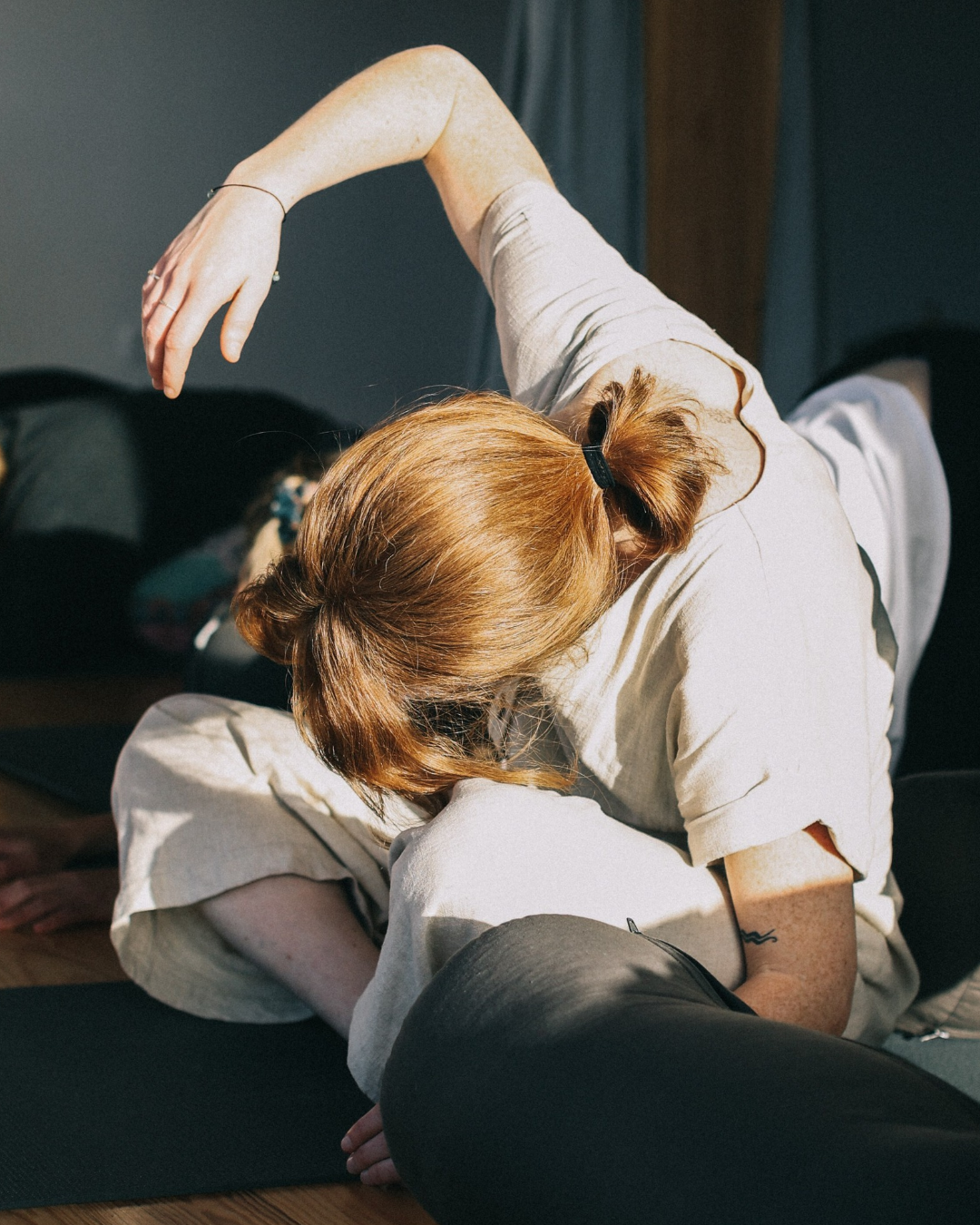
Sometimes somatic movement is expansive and full of energy, as in Shake the Dust or Rhythm & Release. Sometimes it's quieter, slower, almost imperceptible. We pause. We pulse in and out of movement. We notice the spaces between one thing and the next.
It's not about doing less for the sake of doing less, or finding another, more sophisticated way to improve ourselves. It's about changing the questions we ask. Instead of How far can I go? or Am I getting it right?, perhaps we ask, What can I feel? What is responding? What happens if I listen?
Movement as something that connects us to something simultaneously present and ancient.
In a culture that prizes speed, productivity, appearance and measurable results, paying attention to subtle sensation can feel like a quiet disruption. It's a little like entering the dark: when we can no longer rely so heavily on what we see, we have to pay attention differently. We begin to notice what might otherwise go undetected, to listen for the quieter signals, to sense what is happening beyond the edges of our usual attention.
Somatic movement invites something similar. It asks us to value an experience that doesn't necessarily look impressive, produce an outcome or lend itself to a progress chart. Rather than treating the body as an individual project to manage, we begin to sense it as a web of relationships: with gravity, with the ground beneath us, with our surroundings and with other people.
We don't just know we're connected as an idea. We get to feel something of that connection.
I wonder whether this is also why I keep returning to the seasons. They remind us that we don't exist outside the rhythms of the world. We're shaped by them, just as we participate in them. We can't rush autumn into spring, or measure every meaningful change as progress. Some things take time. Some things happen beneath the surface. Some things can only be understood by returning, paying attention and staying curious.
This is what lies at the heart of She Moves with the Seasons. Whether we gather for a year, spend six weeks exploring a season together, or meet on retreat, the invitation is to slow down enough to notice what's happening within us and around us. To feel our bodies as part of the living world, rather than separate from it. To discover, through movement, reflection and time spent together, that belonging isn't necessarily something we have to find or earn. Perhaps it's something we can begin to sense, and feel, when we pay attention differently.
Because perhaps paying attention differently isn't just about noticing what we usually overlook. It's about discovering the connections we've been taught to ignore, and remembering that we were never separate parts in the first place.